

When evaluating feed, not only the raw materials and their contents are crucial for good feed, but also their ratios to one another. An incorrect feed composition can result in serious health problems for the fish.
High in carbohydrates / Low in fat and protein
If more energy is consumed through a diet too rich in carbohydrates than can be used, the excess is not excreted but synthesized into fat or stored in small amounts as glycogen. Glycogen is stored in the liver or muscle tissue, while fat is stored in adipose tissue cells.
Even fish fed a low-fat diet can quickly become obese and suffer serious organ damage if fed too much energy [1] .
High in protein / low in fat and carbohydrates
Fish whose feed consists of too high a protein content and too low a total energy content suffer permanent damage within a very short time. Since the organism lacks the necessary energy from fat and carbohydrates, the fish is forced to use protein for energy production (gill strain).
Protein-rich, fat-rich and low-carbohydrate
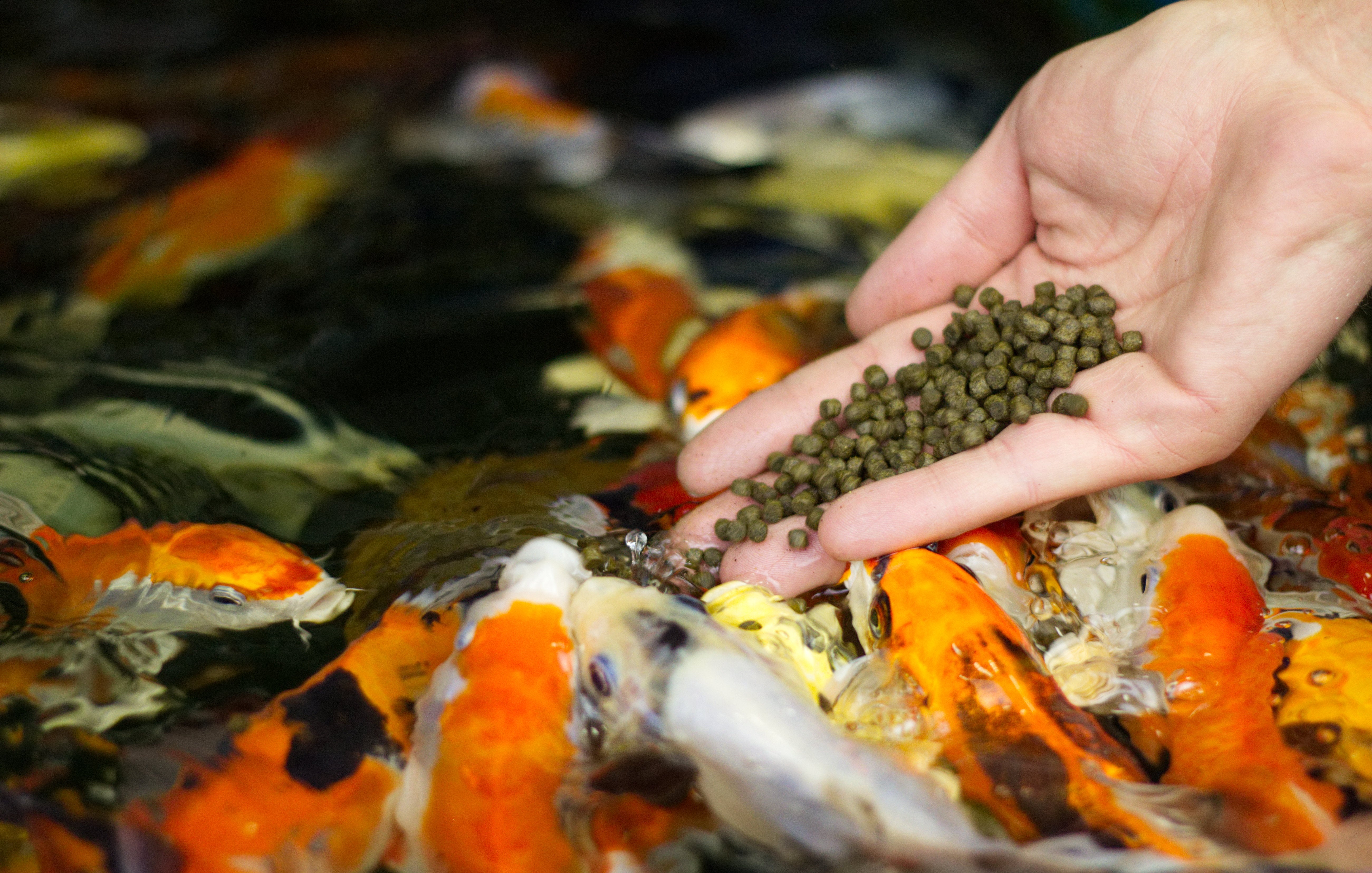
This combination offers several advantages. The koi have sufficient protein available for growth, along with ample energy, thus reducing the amount of energy required for metabolism. This, in turn, lowers the excretion of protein metabolism byproducts (ammonia/ammonium). Furthermore, a smaller quantity of food is needed to meet their nutritional requirements. It is crucial with this nutrient composition that the fish are not fed until they stop eating! Compared to lower-energy feeds, koi require less food.
PH value
In ponds with a high pH (above 9), koi are unable to adequately excrete the increased ammonia production into the water through their gills. Ammonia/ammonium is a metabolic byproduct of cellular protein breakdown. High ammonia excretion can damage the gills (gill necrosis), impairing oxygen uptake [2] . These diseases are increasingly common in Germany. The cause is the predominantly "hard" source water. High pH values above 7 pose significant risks for koi keepers in this regard.
To prevent gill diseases, energy-rich feed with a corresponding fat content (protein/energy ratio - 0.4–0.5 MJ digestible energy per gram of protein [1;2;3] ) can be used. This relieves the strain on the gills.
High-quality feed should have a low carbohydrate content of less than 20%, consist of high-quality animal raw materials, have 0.4 – 0.5 MJ of digestible energy per gram of protein, and contain over 35% protein.
Scientific sources:
[1] Geldhauser, F. & Gerstner, P. (2011): The Pond Farmer. Carp and Other Fish . 9th revised edition. Ulmer Stuttgart, pp. 76–93.
[2] Schäperclaus, W. & Lukowicz, MV (1998): Textbook of Pond Management . 4th revised edition. Parey. Berlin, pp. 51–209.
[3] Schreckenbach, K. (2015): Nutrition of carp in ponds: Koi hobby . Institute for Inland Fisheries e. V. Potsdam-Sacrow.